

What you can do with Super GTM
Deep integrations
Connect your CRM, calendar, email, call recordings, support tickets, and other GTM tools
Agent execution
Run any agent you’ve built in Relevance AI directly from Chat
End-to-end autonomy
Execute multi-step workflows across your connected tools
Persistent context
Memories, files, tasks, and skills that carry across sessions
Getting started
Prerequisites
- You must be on an Enterprise plan with Relevance AI.
- Requires enrollment in the Super GTM closed beta. Contact your account team to request access.
Enrollment
Super GTM is enabled by Relevance staff after discussion with your Account Executive (AE).By user
Provide a list of email addresses to your AE
By domain
Enable for all users with a specific email domain
Accessing Super GTM
- Web
- iOS (TestFlight)
- Navigate to chat.relevanceai.com
- Click the model picker in the chat interface
- Enable the Super GTM mode toggle
- Start working across your GTM stack
Configuring Super GTM
Tailor Super GTM to your workflow across three areas:Integrations
Connect your CRM, calendar, email, and other tools across your GTM stack
Capabilities
Control content creation, file editing, user preferences, and memory
Agents
Choose which of your Relevance AI agents are available, such as Slide Builder
Integrations
To get the most out of Super GTM, start by connecting your integrations. Click the gear icon next to the Super GTM toggle to open the settings panel, find the integration you want to enable, and click “Connect account” or “Add API key”.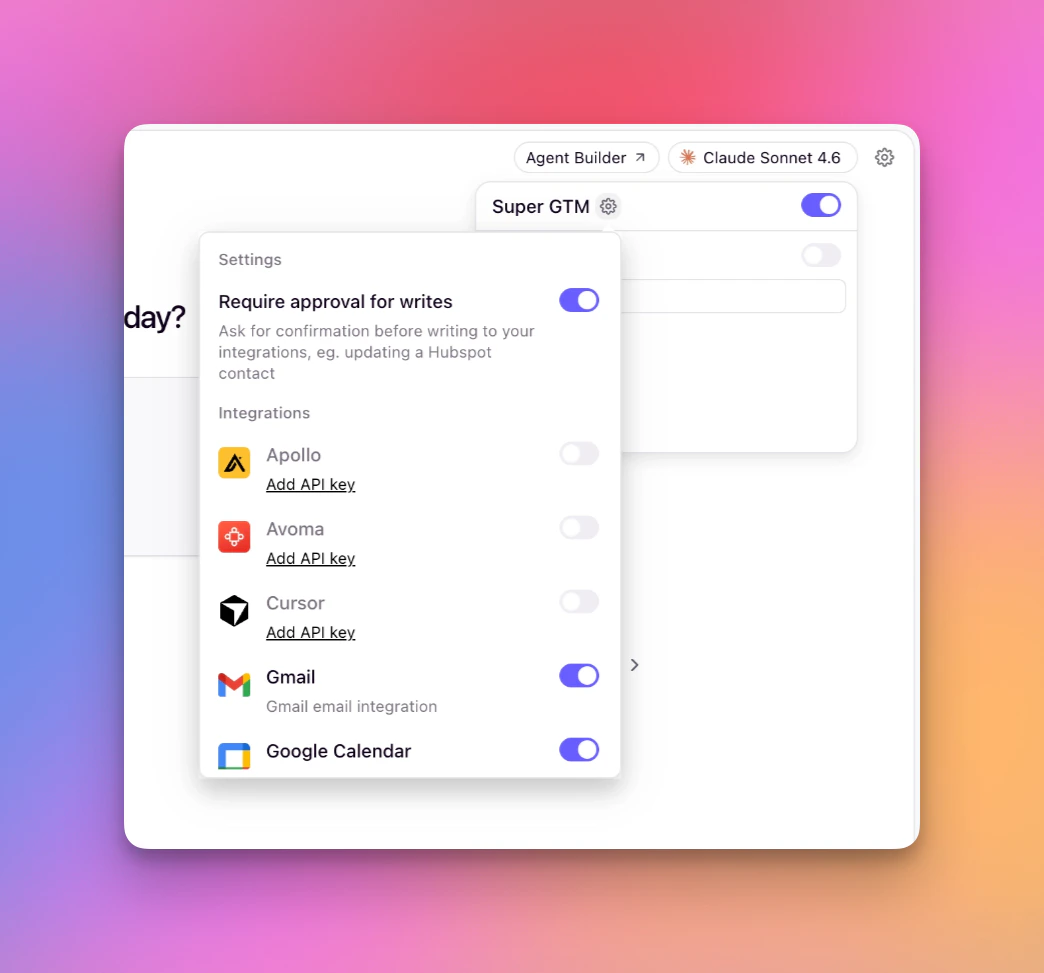
- OAuth: Each user authorizes their own connection via a popup modal. Each user needs to connect their apps individually.
- API key: Add an API key to a Relevance project, which can be used by all users in that project. These can be centrally managed on a project basis in the builders app under Integrations & API Keys.
Depending on how your organization has configured each external application, you may need to request admin access to enable OAuth access or to obtain an API key. Check with your IT team or admin of the external application to confirm.
Supported integrations
- OAuth
- API Key
| Application | Permissions |
|---|---|
| HubSpot | Read, create, update, delete and search CRM objects (contacts, companies, deals, etc.). List owners. |
| GSuite (Calendar, Gmail, Docs) | Gmail: Read, send, draft and label emails. Calendar: Create events and check availability. Docs: Read and edit documents. |
| Linear | Read, create, update and archive issues. Read, create and update comments. Read projects and labels. |
| Notion | Read, create and update pages. Query and create databases. Create comments. Manage blocks. Search workspace. |
| Slack | Read and post messages. Search messages. Manage channels. List users. Add reactions. |
| Salesforce | Read and write CRM data via API. Run SOQL queries. |
| Microsoft Calendar | Create and manage calendar events including on shared calendars. |
| Microsoft Outlook | Read, send and draft emails. Manage labels and mailbox settings. |
| Microsoft Teams | Read and send chat and channel messages. Read meeting transcripts. Manage online meetings. |
Action approval
The agent can never send, create, update, or delete anything without your explicit confirmation.
- Approve the action to let it proceed as-is.
- Reject the action to prevent it from executing.
Filesystem explorer
Super GTM includes a persistent virtual filesystem that stores memories, skills, and files across sessions. The filesystem explorer in the chat sidebar shows which files your agent has access to and how it interacted with them.File access indicators
As the agent works, the file tree displays visual indicators so you can see at a glance which files it has interacted with, without reviewing individual tool call logs.- Amber dot + amber text — the agent wrote to this file
- Gray dot — the agent read this file but did not modify it
- Folder icons also display these indicators when any file inside was accessed
File system structure
The virtual filesystem is organized into several top-level directories:| Directory | Purpose |
|---|---|
/skills/project/ | Project-wide skills shared across all team members |
/skills/user/ | Personal skills visible only to you |
/memory/ | User memory files, with MEMORY.md as an index |
/project_filesystem/ | Shared project knowledge accessible to all users |
/{mount}/ | External integration mounts (e.g., Google Drive) |
Integration mounts
When you connect an external integration that supports filesystem access, it appears as a virtual mount in the file tree. Each mount includes aREADME.md that describes how to interact with the integration — the agent reads this before using the mount for the first time.
Agents interact with integration data by reading from and writing to mount directories. For example, a Google Drive integration appears as a /google-drive/ mount where the agent can browse folders, read documents, and create files.
Managing files
You can create new folders and files directly from the filesystem explorer UI. Use descriptive names and a logical folder structure — agents rely on file names and paths when searching for context. Regularly review the file access indicators to understand what your agent is reading and writing during a session, and clean up unused files to keep the filesystem tidy. Permissions:- Project-level files (under
/skills/project/and/project_filesystem/) can only be written or deleted by project admins. - User-level files (under
/skills/user/and/memory/) are private to the owning user. - Virtual skills (presets, agents-as-skills) are always read-only and cannot be edited via the filesystem.
Skills
Skills are repeatable workflows that Super GTM can invoke during a chat session. Think of agents as the “doers” and skills as the “how-to guides” — skills give agents the step-by-step instructions and context they need to perform tasks correctly.How skills work
At the start of each conversation, Super GTM loads allSKILL.md files found in the /skills/user/ and /skills/project/ directories. These are parsed and added to the skills catalog for that session.
A skill can be invoked in two ways:
- Manually — you explicitly ask Super GTM to use a specific skill by name
- Automatically — when your request matches a skill’s
when_to_usetrigger, Super GTM invokes the skill without being asked
/skills/user/) or project-wide (stored in /skills/project/). Project skills are shared across the entire team and can only be created or modified by project admins.
Creating skills with the skillify flow
The easiest way to create a new skill is through the skillify flow — an agent-guided interview that captures everything needed to define a reliable, reusable skill. To start the skillify flow, tell Super GTM you want to create a new skill. For example:“Create a skill for how I like to qualify new leads”SuperGTM will guide you through a structured interview covering:
- Skill name and description — what the skill is called and what it does
- Goals and success criteria — what a successful outcome looks like
- Step-by-step breakdown — the exact steps the agent should follow
- Arguments — any inputs the skill requires (e.g., a contact name, deal ID)
- Triggers — phrases or conditions that should automatically invoke the skill
- Edge cases and corrections — known exceptions and how to handle them
SKILL.md file to either /skills/user/{skill-name}/SKILL.md or /skills/project/{skill-name}/SKILL.md depending on whether you want it to be personal or shared.
SKILL.md format
Each skill is stored as aSKILL.md file with YAML frontmatter followed by the skill body.
Example SKILL.md file
Example SKILL.md file
when_to_use field is what Super GTM uses for automatic skill matching. Write it as a clear, natural-language description of when the skill should be invoked.
Managing skills
View skills
Open the filesystem explorer and browse
/skills/user/ or /skills/project/ to see all available skillsEdit a skill
Click any
SKILL.md file in the filesystem explorer to open and edit it, or ask Super GTM to update an existing skillDelete a skill
Select the skill folder in the filesystem explorer and delete it, or ask Super GTM to remove a skill by name
Share a skill
Project admins can move a personal skill to
/skills/project/ to make it available to the whole team/skills/user/— only the owning user can create, edit, or delete their skills/skills/project/— only project admins can create, edit, or delete project-wide skills; all team members can invoke them
Best practices
- Write
when_to_usetriggers as clear, specific sentences describing the scenario — vague triggers cause unintended matches - Include detailed step-by-step instructions; the more precise the steps, the more consistently the agent will execute the skill
- Document edge cases explicitly so the agent knows how to handle exceptions
- Test a new skill with several different phrasings to verify automatic matching works as expected
- Keep skill names short and descriptive so they’re easy to reference manually
Example use cases
- Integrations
- Agents
- Skills
Once your integrations are configured, simply ask Super GTM to work with them naturally:
- “Find all open deals in Salesforce for ACME Corp”
- “Schedule a follow-up meeting with Sarah next Tuesday at 2pm”
- “Draft an email to the customer about their support ticket”
- “Create a new contact in HubSpot for John Smith at Example Inc”
Frequently asked questions
How do I get access to Super GTM?
How do I get access to Super GTM?
Super GTM is in closed beta (started March 2, 2026) for Enterprise customers. Contact your Account Executive to discuss enrollment. Access is enabled on a per-user or per-domain basis by Relevance staff after discussion with your AE.
Can I disable the approval flow?
Can I disable the approval flow?
No. The approval flow is a core safety feature of Super GTM and cannot be disabled. It ensures you maintain control over all actions that modify data in your systems.
What happens if I reject an action?
What happens if I reject an action?
If you reject an action, Super GTM will not execute it. The agent will ask how you’d like to proceed. You can provide different instructions, modify the action, or cancel the task entirely.
Can I use Super GTM with my existing agents?
Can I use Super GTM with my existing agents?
Yes! Super GTM can run any agent you’ve built in Relevance AI. Just configure which agents to make available in the Super GTM settings.
What's the difference between OAuth and API key integrations?
What's the difference between OAuth and API key integrations?
OAuth creates individual connections where each user authorizes their own account via a popup modal. API keys are added to a Relevance project and shared across all users in that project. These can be centrally managed in the builders app at app.relevanceai.com under “Integrations & API Keys”. Depending on your organization’s configuration, you may need admin access for either method. Check with your IT team.
Does Super GTM work on mobile?
Does Super GTM work on mobile?
Yes! Super GTM is available on iOS via TestFlight. Install the TestFlight app, then open the beta invite link to install Relevance AI. Turn on automatic updates in TestFlight to stay up-to-date.
What integrations are supported?
What integrations are supported?
OAuth integrations (per-user): HubSpot, GSuite (Calendar, Gmail, Docs), Linear, Notion, Slack, Salesforce, Microsoft Calendar, Microsoft Outlook, and Microsoft Teams. API key integrations (project-wide): Cursor, Apollo, Gong, and Linear. See the Supported integrations table for full details on permissions.
Can Super GTM access data from multiple tools at once?
Can Super GTM access data from multiple tools at once?
Yes! Super GTM can work across multiple tools simultaneously. For example, it can pull data from your CRM, check your calendar, and draft an email, all in a single conversation.
What's the difference between personal and project skills?
What's the difference between personal and project skills?
Personal skills are stored in
/skills/user/ and are only visible to you. Project skills are stored in /skills/project/, are shared with everyone in the project, and can only be created or modified by project admins. Both types are available during your chat sessions.Do files and skills persist between sessions?
Do files and skills persist between sessions?
Yes. The virtual filesystem is backed by S3 and persists across all chat sessions. Skills, memory files, and any files you or the agent create remain available in future conversations.